
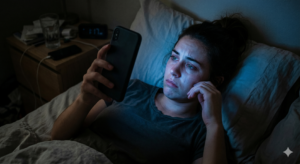
We’ve all been there. It’s 11:30 PM, you’re exhausted, and you just wanted to check your phone one last time before going to sleep. Forty-five minutes later, you are deep in a rabbit hole of devastating global news, alarming economic forecasts, and angry social media commentary. Your jaw is clenched, your heart is racing, and sleep is nowhere in sight.
Welcome to doomscrolling.
First coined around the early 2020s and officially added to the dictionary shortly after, doomscrolling is the compulsive, repetitive consumption of negative or distressing digital content. It feels like you are trying to stay informed, but in reality, you are trapping your brain in a cycle of stress. Let’s break down exactly why our brains are drawn to the doom, how it impacts our mental health, and what we can actually do to stop.
Why We Can’t Look Away
If doomscrolling makes us feel miserable, why is it so hard to stop? The answer lies in a combination of human evolution and modern technology.
-
The Negativity Bias: From an evolutionary standpoint, our brains are hardwired to prioritize threats. Thousands of years ago, paying hyper-attention to danger (like a predator) kept us alive. Today, your brain treats an alarming headline the exact same way—triggering your attention and refusing to let go.
-
Intolerance of Uncertainty: Psychologists note that when the world feels unpredictable, we crave answers. We scroll through bad news to find some illusion of control, subconsciously thinking, “If I just read a little more, I’ll be prepared.”
-
Algorithmic Traps: Social media platforms are designed for engagement, not for your peace of mind. Algorithms quickly learn that anger, fear, and outrage keep you clicking. Combined with features like infinite scrolling and autoplay, digital platforms remove natural “stopping points,” making it incredibly difficult to break away.
The Reality Check: Doomscrolling rarely informs us; it mostly just inflames us. You aren’t gaining a survival advantage—you are just exhausting your nervous system.
The Mental Health Toll
Recent studies from 2024 and 2025 have heavily researched the psychological toll of this modern vigilance, and the results are sobering. Engaging in constant doomscrolling goes far beyond a temporary bad mood; it physically and mentally alters our stress responses.
1. The Cortisol Trap
When you consume distressing news, your brain’s alarm system (the amygdala) fires up your fight-or-flight response, dumping stress hormones like cortisol and adrenaline into your body. Because the scrolling doesn’t stop, your nervous system remains switched “on.” Over time, this constant activation wears you down, leading to chronic physical fatigue, tension headaches, and an inability to relax.
2. Sleep Procrastination and Exhaustion
Doomscrolling heavily predicts poor sleep quality. Many people engage in “revenge bedtime procrastination” by scrolling late at night. Not only does the blue light disrupt your circadian rhythm, but the anxiety spikes your heart rate precisely when your body needs to be winding down.
3. Existential Anxiety and Depression
Heavy doomscrollers experience significant reductions in life satisfaction. Constantly consuming the worst of humanity creates a distorted worldview—a phenomenon known as “Mean World Syndrome.” It can trigger existential anxiety, feelings of hopelessness, irritability, and a loss of meaning in daily life.
How to Take Back Your Feed (and Your Mind)
You don’t have to throw your phone in the ocean and move to the woods to protect your mental health. You just need to create intentional friction between yourself and the endless feed. Here is how you can regain control:
-
Schedule Your Scrolls: Instead of checking the news during every spare moment, set a dedicated 15-minute window for it (e.g., after breakfast, but never right before bed). Structured news exposure keeps you informed without allowing it to hijack your entire day.
-
Curate a Positive Feed: Algorithms feed you what you interact with. Deliberately seek out and engage with content that highlights progress, solutions, humor, or your personal hobbies. Give your brain a chance to engage in healthy “dopamine-scrolling” rather than doomscrolling.
-
Use Tech to Fight Tech: Turn off non-essential push notifications for news and social media apps. Utilize app timers or blockers (like ScreenZen) that monitor your scrolling and physically lock you out of an app after a set time limit.
-
Evict Your Phone from the Bedroom: If your phone is your alarm clock, it’s too easy to start scrolling in bed. Buy a cheap, physical alarm clock and charge your phone in the kitchen or hallway overnight.
-
Move Your Body: When you feel the tension of a doomscrolling spiral setting in, break the physical loop. Put the phone down, stand up, stretch, or take a 10-minute walk outside. Physical activity clears cortisol from your system and grounds you back in the present reality.
Final Thoughts
It is completely normal to feel overwhelmed by the state of the world, and wanting to stay informed means you care. But you cannot help the world if your own mental health is running on empty. Setting boundaries with your digital consumption isn’t ignorant—it’s an act of necessary self-preservation.
Tonight, when you feel the urge to swipe open that app and look for the latest disaster, take a deep breath, put the device down, and choose to protect your peace instead. The news will still be there tomorrow.